
Spotting Melanoma Early: A Practical Guide for Parents and Carers
Looking after other people’s health often means noticing things they have not. A parent sees the new freckle on a teenager’s shoulder, and a carer sees the dark patch on an older relative’s back while helping with a shower.
Melanoma is rare in young children but not unknown, and the adults and teenagers in a household are the ones most likely to benefit from a second pair of eyes.
How to Include Regular Skin Checks in Family Routines
Skin checks work best as a routine rather than an event. Once a month is enough for most households, and it takes about ten minutes with decent light and a mirror. The aim is to learn what each person’s skin normally looks like, so that a change stands out instead of being lost among dozens of unremarkable moles.
Back, scalp, ears, the backs of the legs, and the spaces between toes are the places a person cannot see alone. Helping a teenager, a partner or an elderly relative check them is a practical use of a few minutes, and most people accept it more easily when it is framed as routine rather than worry.
Understanding melanoma and its treatment can also help families recognise the importance of regular checks. For more information, read this specialist overview of melanoma and skin cancer: https://drjameswilson.co.uk/conditions/melanoma-skin-cancer/
Recognising the Early Warning Signs of Melanoma
A new mole or a change in an existing mole may be a sign of melanoma. Melanomas can appear anywhere on the body, though they are more common in areas that are often exposed to the sun, and some rarer types affect the eyes, the soles of the feet, the palms of the hands or the genitals.
The NHS guidance on symptoms of melanoma skin cancer describes the warning signs in plain terms. Normal moles are usually round with smooth edges, while melanomas are often an uneven shape, with two different-looking halves and ragged borders. Normal moles are usually one colour, whereas melanomas are often a mix of two or more. Most normal moles are about the size of a pencil end or smaller, and melanomas tend to be wider than 6mm, though early ones can be smaller.
Change matters more than any single feature. A mole that alters in size, shape or colour deserves attention, as does one that becomes swollen, sore, itchy, crusty or starts to bleed. The same page advises seeing a GP for a new or unusual mark that has not gone away after a few weeks, including on palms and soles, and for a dark area under a nail that an injury does not explain. Absence of discomfort offers no reassurance, because most melanomas do not cause pain or itching, and presence of itching does not mean cancer, since some harmless moles itch too. The visual change is the signal to act on.
Monitoring Moles and Skin Changes in Children and Teenagers
Moles appear and change throughout childhood, so the useful question is how a mark compares with last month rather than whether it looks perfect. Growth in step with the child, with an even colour and smooth edge, is usually unremarkable. A single spot that looks different from its neighbours, or that grows faster than the child does, is the one worth showing a doctor. Sunburn in childhood and adolescence raises the risk of melanoma later in life, and ultraviolet light from the sun and sunbeds is the main cause of the disease, so shade, clothing and sunscreen habits formed early are a form of protection that lasts.
A dated photograph taken beside a ruler or a coin gives a GP something concrete to compare. Phone cameras are good enough, and keeping the pictures in one album avoids the awkward moment of trying to remember how a mark looked three months ago.
Recognising Melanoma in Different Skin Tones and Less Visible Areas
People with brown or black skin are less likely to develop melanoma, but they can still get it. In darker skin, it more often appears on the palms, the soles of the feet and under the nails, places that sun protection advice rarely mentions and that families seldom think to inspect.
A dark streak under a nail that has not been caused by a knock, or a new patch on a foot that does not fade, should be looked at by a GP, whatever the person’s age or skin tone. The same applies to mouth and genital areas, which are rare sites but easy to forget when the conversation feels awkward.
Carers supporting someone with limited mobility can build a check into routines already in place, such as dressing or bathing, so that the exam does not become a separate chore.
Records help when the person being checked cannot easily describe their own history. A short note kept with the person’s medication list, saying which marks were looked at and on what date, lets a different carer, a district nurse or a GP see at once whether a spot is new.
What to Expect When a GP Examines a Suspicious Mole
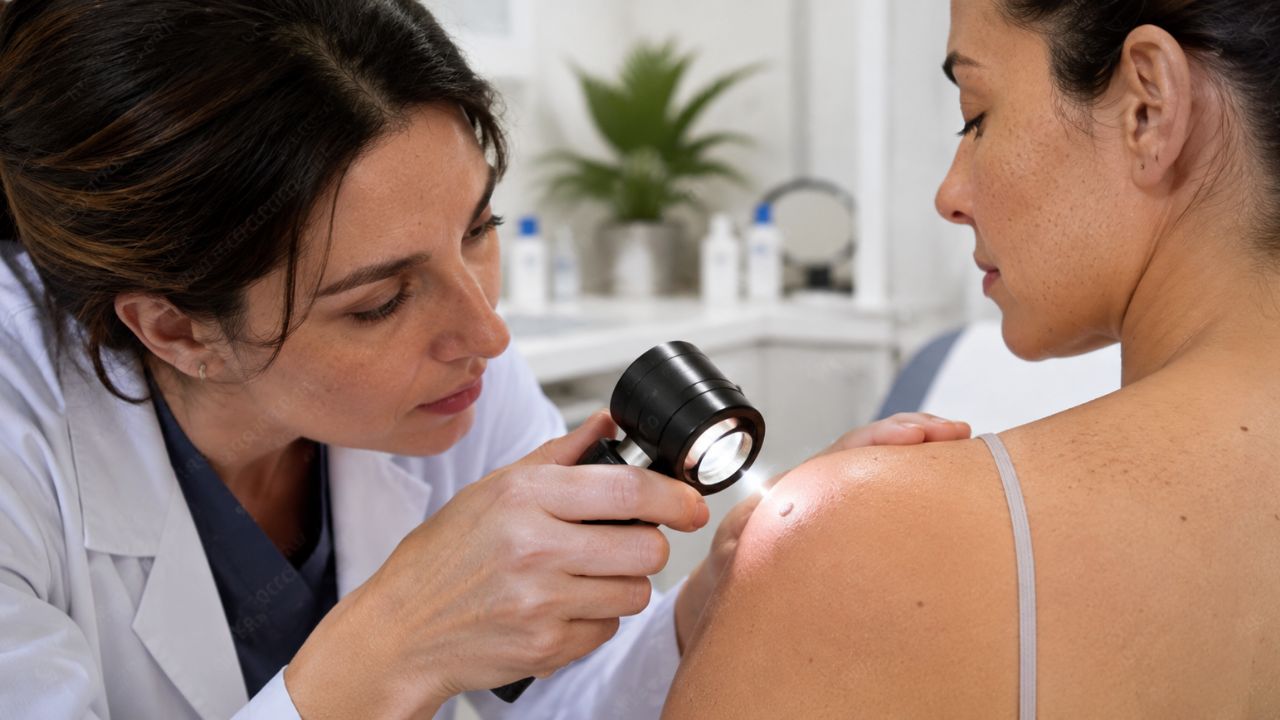
A GP will ask about the person’s health, any family history of skin cancer and when the mark first appeared or changed. Bringing the dated photographs helps. The GP will examine the mole and other areas of skin, and may ask permission to photograph it so that a dermatologist can review the picture remotely, a service known as teledermatology.
An urgent referral for tests or a hospital specialist does not mean cancer has been found. The referral means the GP wants an expert to look soon, and the NHS guidance is explicit that it does not definitely mean cancer. Most referred moles turn out to be harmless, and the appointment still counts as time well spent.
Parents and carers often feel they are overreacting when they raise a concern. Surgeons would rather see a harmless mark than miss one that matters, so a question asked early is never wasted. A person who is referred and then cleared should carry on with the monthly checks, since the all-clear applies to one mark on one day and says nothing about the next one. Asking the GP how long the hospital is likely to take to make contact, and which symptoms should prompt a call sooner, gives the family a clear plan while they wait.